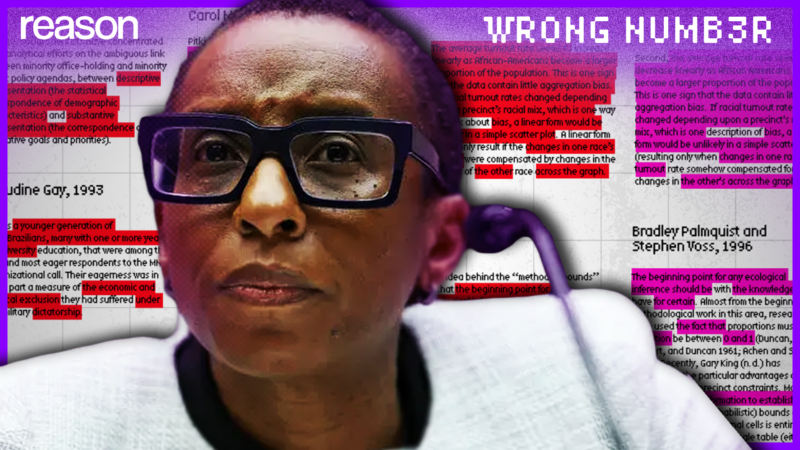
After surviving a disastrous congressional hearing, Claudine Gay was forced to resign as the president of Harvard for repeatedly copying and pasting language used by other scholars and passing it off as her own. She's hardly alone among elite academics, and plagiarism has become a roiling scandal in academia.
There's another common practice among professional researchers that should be generating even more outrage: making up data. I'm not talking about explicit fraud, which also happens way too often, but about openly inserting fictional data into a supposedly objective analysis.
Instead of doing the hard work of gathering data to test hypotheses, researchers take the easy path of generating numbers to support their preconceptions or to claim statistical significance. They cloak this practice in fancy-sounding words like "imputation," "ecological inference," "contextualization," and "synthetic control."
They're actually just making stuff up.
Claudine Gay was accused of plagiarizing sections of her Ph.D. thesis, for which she was awarded Harvard's Toppan Prize for the best dissertation in political science. She has since requested three corrections. More outrageous is that she wrote a paper on white voter participation without having any data on white voter participation.
In an article in the American Political Science Review that was based on her dissertation, Gay set out to investigate "the link between black congressional representation and political engagement," finding that "the election of blacks to Congress negatively affects white political involvement and only rarely increases political engagement among African Americans."
To arrive at that finding, you might assume that Gay had done the hard work of measuring white and black voting patterns in the districts she was studying. You would assume wrong.
Instead, Gay used regression analysis to estimate white voting patterns. She analyzed 10 districts with black representatives and observed that those with more voting-age whites had lower turnout at the polls than her model predicted.
Popular Podcasts
Stuff You Should Know
If you've ever wanted to know about champagne, satanism, the Stonewall Uprising, chaos theory, LSD, El Nino, true crime and Rosa Parks, then look no further. Josh and Chuck have you covered.
Dateline NBC
Current and classic episodes, featuring compelling true-crime mysteries, powerful documentaries and in-depth investigations. Follow now to get the latest episodes of Dateline NBC completely free, or subscribe to Dateline Premium for ad-free listening and exclusive bonus content: DatelinePremium.com
My Favorite Murder with Karen Kilgariff and Georgia Hardstark
My Favorite Murder is a true crime comedy podcast hosted by Karen Kilgariff and Georgia Hardstark. Each week, Karen and Georgia share compelling true crimes and hometown stories from friends and listeners. Since MFM launched in January of 2016, Karen and Georgia have shared their lifelong interest in true crime and have covered stories of infamous serial killers like the Night Stalker, mysterious cold cases, captivating cults, incredible survivor stories and important events from history like the Tulsa race massacre of 1921. My Favorite Murder is part of the Exactly Right podcast network that provides a platform for bold, creative voices to bring to life provocative, entertaining and relatable stories for audiences everywhere. The Exactly Right roster of podcasts covers a variety of topics including historic true crime, comedic interviews and news, science, pop culture and more. Podcasts on the network include Buried Bones with Kate Winkler Dawson and Paul Holes, That's Messed Up: An SVU Podcast, This Podcast Will Kill You, Bananas and more.